
Is Google Business Profile Losing Its Power? What Small Businesses Need to Know About AI Search
For years, one of the most effective tools we had for helping small businesses compete online was also one of the most affordable: Google Business Profile.
We spent years learning how to get the most out of these listings. We kept them updated, added fresh content, managed reviews, maintained accurate business information, and made sure our clients were doing things their competitors often overlooked. And it worked.

As AI changes how customers search for local businesses, traditional GBP strategies may be losing some effectiveness. Staying competitive means adapting to a new era while building on strategies that still work.
For many small businesses, especially those without enormous advertising budgets, a properly managed Google Business Profile could make a real difference.
It helped them appear in local searches, generate phone calls, bring customers to their websites, and compete against businesses spending considerably more money on marketing.
I have always believed that small businesses deserve the opportunity to compete without having to outspend everyone else. Finding smarter, more affordable ways to accomplish that has been a big part of my career.
But something is changing. And I believe business owners need to understand what's happening before they find themselves wondering where their customers went.
We Started Seeing Something That Concerned Us
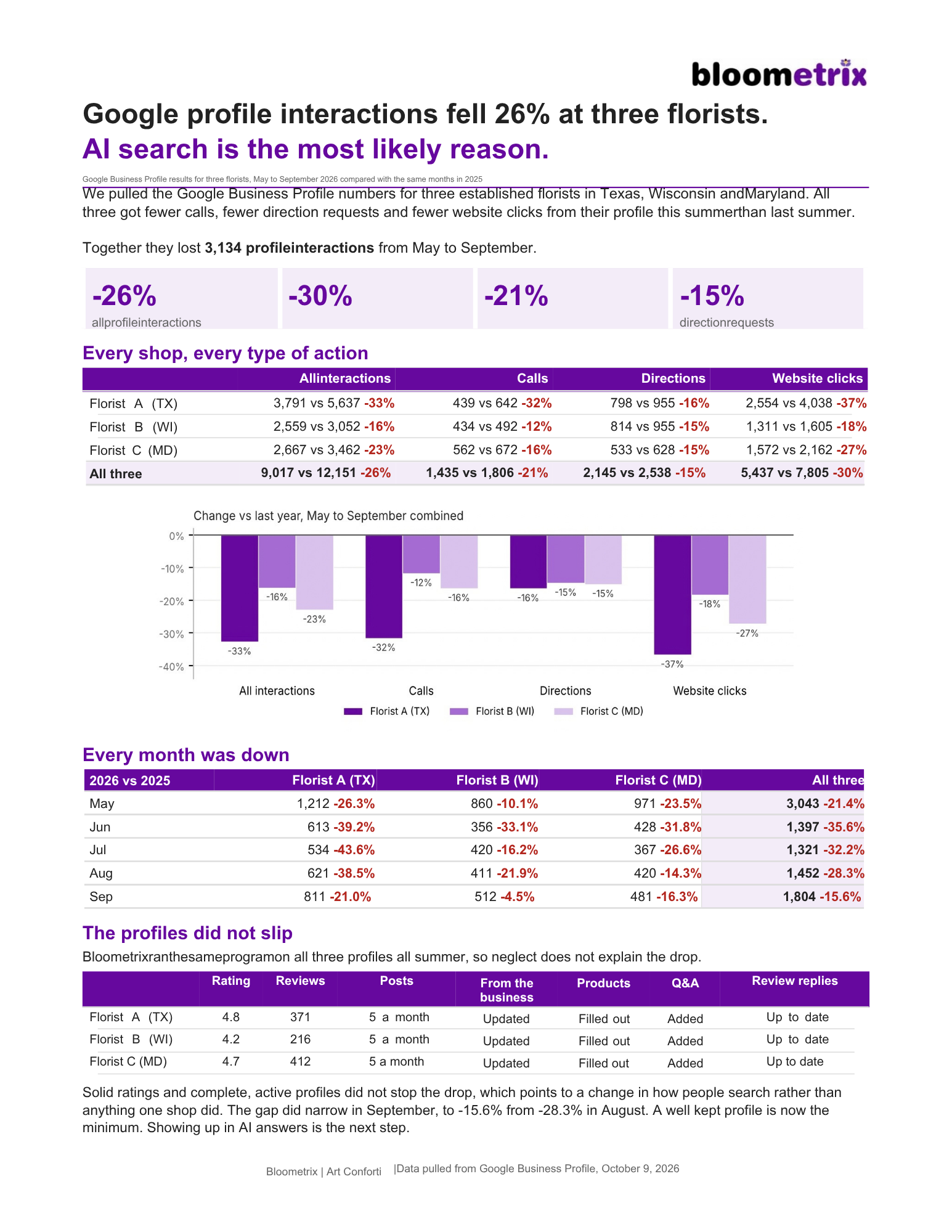
Recently, we reviewed Google Business Profile performance for three established florist clients in Texas, Wisconsin, and Maryland. We compared their results from May through September 2026 with the same period in 2025.
These weren't neglected listings. All three businesses had active, professionally maintained profiles. Their information was current, products were listed, reviews were being managed, and fresh posts were being added regularly. Yet all three experienced significant declines in customer interactions.
Here is what we found across the three businesses:
26% fewer total interactions with their Google Business Profiles.
30% fewer website clicks from those profiles.
21% fewer phone calls generated through the profiles.
15% fewer requests for driving directions.
Together, those three businesses recorded approximately 3,134 fewer Google Business Profile interactions over just five months. That's a substantial change, especially for small businesses that depend on local customers.
And here's what really caught my attention: We hadn't stopped doing the work.
The listings were still being maintained. The businesses still had established reputations. We were continuing to follow the practices that had helped produce results for years. So what changed?
The Customer Is Still Searching. But the Search Experience Is Changing.
I believe artificial intelligence is a major part of the answer. Think about how people traditionally searched for a local business. Someone looking for a florist, dentist, roofer, or restaurant would type a few words into Google. They would see a map, a group of local businesses, and links to websites. They could compare reviews, visit websites, and make phone calls.
Google Business Profile was central to that experience. Now imagine that same customer asking ChatGPT or Google's AI tools, "Who's the best florist near me that can deliver sympathy flowers today?"
Instead of presenting a long list of businesses to investigate, an AI tool may provide a few recommendations and explain why those businesses are worth considering. The customer might never see the traditional list of Google Business Profiles.
And if your business isn't among the recommendations, you may never have the opportunity to compete for that customer. This isn't just speculation about where technology might be heading.
According to BrightLocal's 2026 consumer research, 45% of surveyed consumers had used AI tools for local business recommendations, compared with just 6% in the previous year's survey.
Pew Research Center also found that people clicked traditional Google search results in only 8% of visits when an AI summary appeared, compared with 15% when no AI summary was present. Those are meaningful changes in how customers discover businesses.
Now, I want to be careful about something. Our three-client study shows that Google Business Profile interactions declined. It doesn't prove that AI caused every lost interaction. Advertising changes, competition, search-result layouts, and other factors may also contribute.
But when I look at our clients' results alongside what's happening throughout the search industry, I see a clear warning: relying on yesterday's local search strategy alone is becoming increasingly risky.
Does This Mean Google Business Profile Is No Longer Important?
Absolutely not. In fact, abandoning your Google Business Profile would be one of the worst conclusions you could draw from this research.
Your listing still provides valuable information about your business. Customers still use Google Maps, read reviews, check business hours, request directions, and call businesses directly from Google. AI doesn't eliminate the need for accurate business information. It makes that information important in new ways.
A recent BrightLocal study of more than 200,000 local AI searches found that strong Google Maps visibility doesn't automatically translate into being recommended by AI. It also found that business websites remain important sources of information for AI-generated recommendations. That's an important distinction.
A strong Google Business Profile is still part of the foundation. It just can't be the entire strategy anymore.
For years, we focused heavily on helping Google understand and recommend our clients. Now we need to help a growing number of AI-powered search systems understand who those businesses are, what they offer, where they operate, and why customers should consider them.
The objective hasn't changed. We still want customers to find our clients. What's changing is how we accomplish it.
So What Can Small Businesses Do About It?
This is the part I consider most important. I don't believe in telling business owners that everything is changing, frightening them with statistics, and then leaving them wondering what to do. Small businesses need solutions, not another problem.
At our company, we're adjusting our approach to local search by combining the traditional strategies that still work with newer techniques designed to improve visibility in AI-powered search.
Some people call this Generative Engine Optimization (GEO) or Answer Engine Optimization (AEO). Whatever name you use, the objective is straightforward: make your business easier for both search engines and AI tools to discover, understand, and recommend.
Here's where we're focusing our efforts.
1. Find Out What AI Is Saying About Your Business
Before making changes, we need to understand where a business currently stands. If someone asks ChatGPT to recommend a florist in your town, does your shop appear? What happens when they ask Google AI Mode or Gemini? Are your competitors being recommended instead? And perhaps just as important, is the information these tools provide about your business accurate?
We're incorporating AI visibility checks into our research so we can better understand which businesses are being recommended, what information is being used, and where opportunities may exist.
AI recommendations can vary, so one search isn't enough to establish a reliable picture. We need to observe patterns over time.
2. Make Your Website More Useful to Customers and AI
For years, businesses were encouraged to build websites around the keywords people typed into Google. Keywords still matter, but today's websites also need to provide clear, useful answers to the questions customers are asking.
For a florist, that might mean explaining same-day delivery options, service areas, sympathy flower etiquette, or how to choose the right arrangement.
For a roofer, it could mean explaining roof replacement costs, storm damage inspections, and the types of roofing systems available locally.
For a dentist, it might mean answering common questions about treatments, appointments, and patient care.
We're placing greater emphasis on creating helpful, specific website content that demonstrates what each business actually knows and does. The goal isn't to fill a website with generic AI-generated articles. It's to publish useful information that reflects the business's real services, experience, and expertise.
3. Build a Consistent, Trustworthy Online Presence
Your Google Business Profile isn't the only place where information about your company appears. Apple Maps, Bing Places, industry directories, review websites, social platforms, and other online sources all contribute to your business's digital presence.
We're continuing to organize and maintain this information because accuracy and consistency matter. When your business name, address, phone number, services, and operating hours agree across reputable sources, customers and search systems have a clearer picture of your company.
We're also continuing to emphasize genuine customer reviews. A strong reputation supported by detailed, authentic feedback remains valuable, whether a customer discovers you through Google, an AI recommendation, or a traditional directory.
4. Help Search Systems Understand What Makes Your Business Different
One of the biggest opportunities for small businesses is communicating what makes them worth recommending.
Maybe your flower shop has served the community for 50 years. Maybe your moving company specializes in difficult waterfront moves. Maybe your dental practice offers a particular treatment or has extensive experience serving local families. Those details matter.
We can help communicate them through stronger About Us pages, relevant service pages, local content, customer testimonials, and properly organized website information.
We also use structured data, often called schema markup, where appropriate to help search systems interpret important details about a business.
None of these techniques guarantees an AI recommendation. But together, they can make a business's online presence clearer, more complete, and more useful.
5. Measure What Matters, Not Just Where You Rank
This may be the biggest adjustment of all. For years, rankings and website traffic were among the most visible measures of search marketing success. They're still important, but they're not the whole picture.
If a customer discovers your company through an AI recommendation and calls you directly, that interaction may not appear in your traditional website traffic reports.
We need to look more closely at actual business outcomes: phone calls, inquiries, appointments, orders, and sales, alongside traditional search performance and emerging AI visibility measurements.
Ultimately, the goal was never simply to rank number one on Google, the goal was to help businesses acquire customers. That hasn't changed.
I Still Believe Small Businesses Can Compete
I've spent much of my career helping independent businesses compete in a marketplace that often seems to favor the biggest players.
I don't want to see small businesses lose the advantages they've worked so hard to build simply because the rules of online search are changing. And I don't believe the answer is to throw away everything we've learned.
The experience, reputation, customer relationships, and local knowledge that make independent businesses special are still valuable. In fact, they may become even more important as AI systems try to distinguish one business from another.
What we need to do is make sure that information is available, accurate, and presented in ways that today's search technology can understand. We're not abandoning Google Business Profile optimization. We're building on it.
We're continuing to maintain listings, improve websites, manage online reputations, create useful content, and strengthen local visibility. But we're also testing new approaches, studying AI recommendations, and adapting our strategies based on what we learn.
I can't promise that every business will appear in every AI answer. Nobody can responsibly make that promise. What I can promise is that we're paying attention, we're doing the research, and we're not standing still.
The Next Step: Find Out Whether AI Can Find Your Business
Here's something you can try today. Open ChatGPT, Google AI Mode, or Gemini and ask a simple question a potential customer might ask when looking for your services. Don't use your business name. Ask for recommendations based on what you do and where you do it.
See which businesses appear. Then try a more specific question about one of your services. You may be surprised by the results. And if your business isn't being recommended, don't assume there's nothing you can do.
We can help you find out where you stand and develop a strategy for where search is going next.
At Bloometrix, we're studying these changes and helping businesses adapt their websites, local listings, and online content for a search environment increasingly influenced by AI.
If you'd like to know how your business appears in AI-powered search, contact us about an AI Visibility Check. We'll examine relevant searches, review what customers and AI systems can find about your company, and identify practical opportunities to improve your online presence.
The way customers search is changing. Our job is to help make sure your business changes with it.
Frequently Asked Questions
Is Google Business Profile still worth maintaining in 2026?
Yes. Google Business Profile remains an important source of business information, customer reviews, map visibility, phone calls, and directions. However, businesses should also develop strategies for visibility in AI-powered search.
Why are Google Business Profile interactions declining?
There can be several reasons, including changes in Google search layouts, increased advertising, competition, and customers using AI-generated answers. Our recent analysis found a 26% decline in interactions across three actively maintained florist profiles, although the data cannot establish exactly how much of that decline was caused by AI.
What is GEO or Generative Engine Optimization?
GEO is the practice of improving a business's online information and content so AI-powered search systems can more easily discover, understand, and potentially recommend it. It complements traditional SEO rather than replacing it.
Can small businesses compete in AI search without a large advertising budget?
There are practical steps that don't require large advertising budgets, including maintaining accurate listings, publishing useful website content, earning genuine reviews, and clearly communicating local expertise. Results vary, and no strategy can guarantee inclusion in AI recommendations.
How can I find out if AI recommends my business?
Start by searching ChatGPT, Gemini, and Google AI Mode using questions your potential customers might ask. Compare the results over time, check for inaccuracies, and review which competitors appear. A more structured AI visibility assessment can help identify opportunities for improvement.