
20 Ingredients for the Perfect Website: A Small Business Guide
Is Your Website Really Working for Your Business?
A great website is more than an attractive design. It should help customers find your business, understand what you offer, trust your expertise, and feel confident taking the next step.
After years of working with businesses on website development, search engine optimization (SEO), and digital marketing, I've learned that successful websites share certain characteristics. Some are obvious, like clear navigation and professional images. Others happen behind the scenes, where search engines and AI-powered platforms evaluate your website to determine how relevant and helpful it is.
That's why we've put together 20 Ingredients for the Perfect Website, a practical checklist that business owners can use to evaluate their websites and identify opportunities for improvement. Whether you're launching a new website or improving one you've had for years, these fundamentals can help you build a stronger online presence.
What Makes a Website Successful?
A successful business website needs to accomplish three important goals: get discovered, earn trust, and turn visitors into customers.
1. Help Customers Find Your Business
Search engine optimization begins with making your website easy for search engines to understand. Clear page headlines, unique SEO titles, descriptive meta descriptions, and dedicated service pages all help communicate what your business does and where it operates. Helpful location pages can also improve your ability to reach customers searching for services in specific communities.
As AI-powered search continues to evolve, this organized, informative content becomes increasingly valuable. Search engines and AI systems need clear information about your business, services, expertise, and location to understand when your website may be relevant to a customer's question.
2. Build Trust Before Customers Contact You
Visitors often make quick decisions about whether a business looks credible. A well-written About Us page, genuine customer reviews, visible trust signals, clear business policies, and an easy-to-find Contact page can make an enormous difference.
Customers want to know who they're doing business with. Providing real information about your company and demonstrating your experience helps make that decision easier. A professional website doesn't just tell people what you sell. It gives them reasons to feel comfortable buying from you.
3. Make It Easy for Visitors to Take Action
Getting people to your website is only half the job. Once they arrive, they should know exactly what to do next. Strong calls to action, intuitive navigation, useful internal links, and a mobile-friendly design help visitors move naturally from learning about your business to contacting you, requesting a quote, scheduling an appointment, or making a purchase.
Fast-loading pages and properly optimized images also matter. A website that is difficult to navigate or slow to load can lose potential customers before they ever reach out. The goal is simple: remove unnecessary obstacles between your customers and your business.
Why These Website Essentials Matter More in the Age of AI
For years, businesses concentrated primarily on getting their websites to appear in traditional Google search results. That remains important, but the way consumers discover businesses is changing.
Today, potential customers may find recommendations through Google AI Overviews, ChatGPT, and other AI-powered search experiences. Instead of simply browsing a list of websites, they may ask a question and receive an AI-generated answer.
This creates a new challenge for business owners: Your website needs to communicate information clearly enough for both people and automated systems to understand.
The fundamentals in our checklist support that goal. Helpful content, clear service descriptions, consistent business information, organized navigation, and signals of credibility all contribute to a stronger digital presence.
No checklist can guarantee that an AI platform will recommend your business. However, a website built around clarity, usefulness, and trust provides a stronger foundation for traditional SEO and emerging approaches such as Generative Engine Optimization (GEO) and Answer Engine Optimization (AEO).
Use Our 20-Point Website Checklist
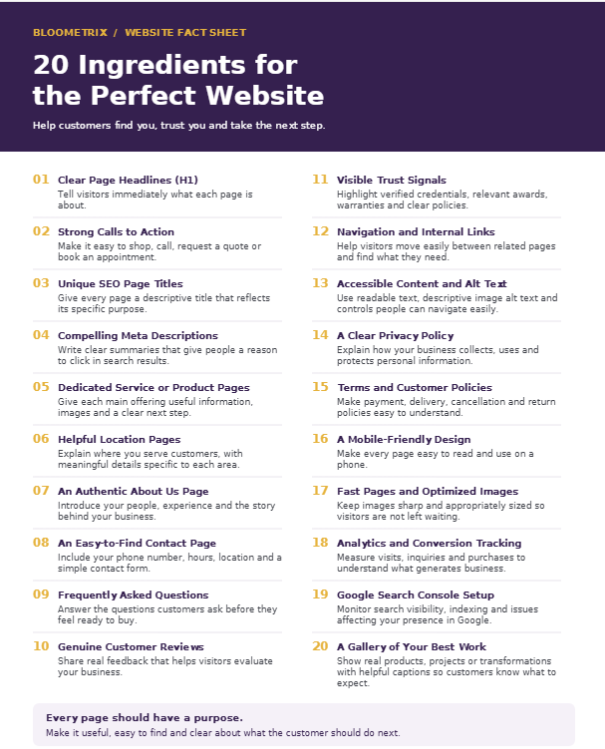
The 20 Ingredients for the Perfect Website: A practical checklist to help business owners improve search visibility, build customer trust, and turn more website visitors into customers.
Take a few minutes to review the checklist and compare it with your current website. Do you have individual pages for your important services? Are your customer reviews easy to find? Can someone visiting on a smartphone quickly locate your contact information? Does every page have a clear purpose?
You may discover that your website already includes many of these ingredients. You may also find opportunities that have been overlooked. You don't necessarily need an entirely new website to make meaningful improvements. Often, updating existing content, improving navigation, adding useful information, and addressing technical issues can make a noticeable difference.
A Great Website Is Never Really Finished
One of the biggest misconceptions about business websites is that once they're launched, the work is done. In reality, your website should evolve alongside your business, your customers, and the technology people use to find you.
New services deserve dedicated pages. Customer questions can become helpful content. Reviews and testimonials should be updated. Website performance should be measured, and improvements should be made based on what the data reveals. Search technology will continue to change. The businesses that maintain accurate, useful, and well-organized websites will be better positioned to adapt.
Let's Find Out What's Missing From Your Website
You don't have to tackle all 20 ingredients at once. Start by identifying the improvements that could have the greatest impact on your business. Sometimes the most valuable change is something as straightforward as a better service page, a clearer call to action, or more helpful information for potential customers.
At Bloomerang Solutions, we work with businesses to improve their websites, strengthen their online visibility, and adapt their digital marketing strategies as search technology evolves.
If you're wondering whether your website has the right ingredients for success, let's talk. We'll help you identify where improvements could make a difference and what steps make sense for your business.
Frequently Asked Questions
What are the most important elements of a successful business website?
A successful website should include clear headlines, informative service pages, easy navigation, mobile-friendly design, visible contact information, customer reviews, and strong calls to action. It should also be technically optimized so search engines can access and understand its content.
How does website design affect SEO?
Website design influences how easily visitors and search engines can navigate and understand your content. Mobile usability, page speed, internal linking, clear headings, and accessible content can support better search performance while improving the customer experience.
Can improving my existing website help me rank better in Google?
Yes. Improving page content, SEO titles, internal links, website speed, and other important elements can help search engines better understand your business. Results vary depending on competition, website condition, and the quality of the improvements.
Does my business website need to be optimized for AI search?
Businesses should consider how AI-powered search tools discover and interpret their information. Clear service descriptions, helpful answers to customer questions, accurate business details, and credible content can make your website easier for these systems to understand, although inclusion in AI-generated answers is never guaranteed.